
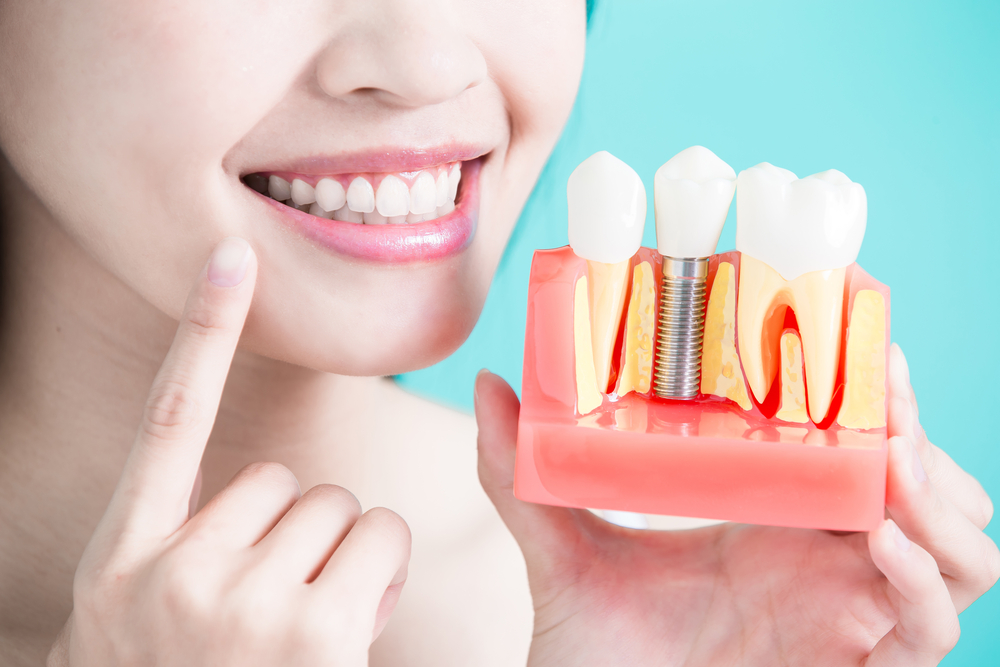
A hybrid denture is a full arch of replacement teeth that is screwed onto dental implants and stays in your mouth. Only your dentist can remove it. It is called a hybrid because it sits between a denture and a bridge: it replaces teeth and gum like a denture, but it is fixed in place like a bridge.
If you have started reading about replacing a whole arch of teeth, you have probably met a pile of overlapping names: hybrid denture, fixed full-arch bridge, All-on-4, All-on-X, overdenture, multi-unit abutment. Many of them describe the same thing from different angles. This guide sorts them out, so that when a dentist describes a treatment plan, you know what each word means.
The hybrid denture, in more detail
A traditional complete denture rests on your gums and is held there by suction, a good fit and sometimes adhesive. A hybrid denture has no plate covering the roof of your mouth and does not rest on the gums for support. Instead, it is attached with small screws to several implants placed in the jawbone, usually four to six per arch.
It usually includes artificial gum as well as teeth. When teeth are lost, the bone and gum that held them shrink over time. The pink section fills that space, so the teeth look the right length and your lips and cheeks have the support they need.
You brush it like natural teeth and clean underneath it with a water flosser or special floss. You do not take it out at night. At your checkups, your dentist can unscrew it to clean and inspect the implants, then put it back.
Names that mean roughly the same thing
Different practices, labs and manufacturers use different names for a fixed full arch on implants. You may see any of these:
- Fixed full-arch bridge or full-arch implant bridge. The most descriptive name: a bridge that spans the whole arch, fixed on implants.
- Fixed implant denture or permanent denture. Common patient-friendly names. “Permanent” means you cannot remove it yourself, not that it never needs maintenance.
- Implant-supported prosthesis. The clinical umbrella term. A prosthesis is any artificial replacement for a body part.
- Full mouth dental implants. Usually means a fixed arch on both the upper and lower jaw, though people also use it for one arch.
When you compare treatment plans, the name matters less than the details behind it: how many implants, what the final teeth are made of, and what the price includes. Our page on full mouth dental implants in Burke, VA sets out what our treatment includes, and our article on what a full-arch quote should include covers what to ask anywhere.
All-on-4 and All-on-X
These names describe a technique rather than a different kind of teeth. All-on-4 is a placement approach, originally developed by an implant manufacturer, that supports a full arch on four implants, with the two back implants angled to make the most of the available bone. “All-on-X” is a looser, generic term for the same idea with however many implants a case needs, often four to six.
In other words, an All-on-4 case usually ends with a hybrid denture. The technique is how the implants go in; the hybrid denture is what goes on top. You can read more on our All-on-4 page, and if you are weighing four implants against a larger number, see All-on-4 vs. traditional implants.
Overdentures: the removable cousin
An overdenture, also called a snap-in or implant-retained denture, looks similar but works differently. It clips onto attachments on two to four implants, or onto a metal bar connecting them, and you take it out every day to clean it. It is much more stable than a conventional denture, and it usually needs fewer implants than a fixed arch.
The key difference is who removes it: you remove an overdenture, and only your dentist removes a hybrid denture. We compare the two in detail in fixed vs removable implant dentures.
The parts underneath
The implant
The implant itself is a small post, usually titanium or a titanium alloy, placed in the jawbone. The FDA regulates dental implants as medical devices and suggests patients ask which brand and model of implant system is being used, and keep a record of it. That is useful if you ever need treatment elsewhere.
Osseointegration
This is the word for bone growing tightly against the implant surface, which is what makes an implant stable enough to carry teeth. It takes time, which is why full-arch treatment usually has two stages: a temporary set of teeth while the bone heals, then the final teeth once the implants have integrated. Our full-arch timeline walks through those stages.
Abutments and multi-unit abutments
An abutment is the connector between the implant and the teeth. Full-arch cases often use multi-unit abutments, a type designed for screwing one large bridge onto several implants. They also correct for angled implants, so all the screw channels line up and the bridge seats in one direction.
Immediate load and the temporary arch
“Immediate load” means attaching teeth to the implants soon after they are placed, often the same day, instead of waiting for healing. When a case is suitable, you leave with a fixed temporary arch rather than no teeth. It is not suitable for everyone; bone quality and how firmly the implants hold on the day decide it. Our article on living with temporary full-arch teeth covers what that phase is like.
What the teeth are made of
Hybrid dentures are made from a few main materials. The classic design is acrylic teeth on a metal framework. Newer options are milled from solid zirconia, a very strong ceramic, sometimes layered with porcelain at the front for a more natural look. The material affects how the arch looks, how it wears and how it handles chewing forces. We compare them in zirconia vs acrylic full-arch teeth.
Is a hybrid denture right for you?
A hybrid denture suits people who are missing all or most of the teeth in an arch, or whose remaining teeth cannot be saved, and who want teeth that stay put. It needs enough bone for the implants, or a plan to work around bone loss, and general health that allows minor oral surgery. If you still have teeth that might be saved, start with your options when most of your teeth are failing.
Dr. Pejman Ghorbani is a general dentist at Shield Dental Care in Burke, VA, and places and restores full-arch implants in our office. A consultation includes a 3D cone beam CT scan, so we can see your bone and explain which option fits. When you are ready, see our current full-arch treatment and pricing, or call (703) 250-5072.
Frequently Asked Questions
Frequently Asked Questions
Frequently Asked Questions
Frequently Asked Questions
Is a hybrid denture the same as All-on-4?+
Not exactly. All-on-4 is a way of placing four implants to support a full arch. The fixed arch of teeth attached to those implants is usually a hybrid denture. One describes the foundation and the other describes the teeth.
Can I take a hybrid denture out myself?+
No. It is screwed onto the implants and only your dentist can remove it, usually at checkups for cleaning and inspection. If you want teeth you can take out, an implant overdenture is the removable alternative.
Why does a hybrid denture have pink gum on it?+
After teeth are lost, the bone and gum that held them shrink. The artificial gum replaces that lost height, so the teeth look the right length and your lips and cheeks are properly supported.
How many implants does a hybrid denture need?+
Usually four to six per arch. The number depends on your bone, your bite and the design of the final teeth, and your dentist decides it from a 3D scan.
What is a multi-unit abutment?+
A connector designed to screw one large bridge onto several implants. It also corrects for implants placed at an angle, so the whole arch can be seated and removed in one direction.
Cavities develop gradually, not overnight. Bacteria in your mouth feed on sugars and starches, producing acids that pull minerals from your enamel. Saliva repairs some damage, but frequent acid attacks overwhelm it, and plaque lets bacteria attack the tooth directly. Left unchecked, decay progresses from the enamel into the dentin, pulp, and eventually an abscess. Good hygiene, diet, and regular dental visits keep cavities preventable.