
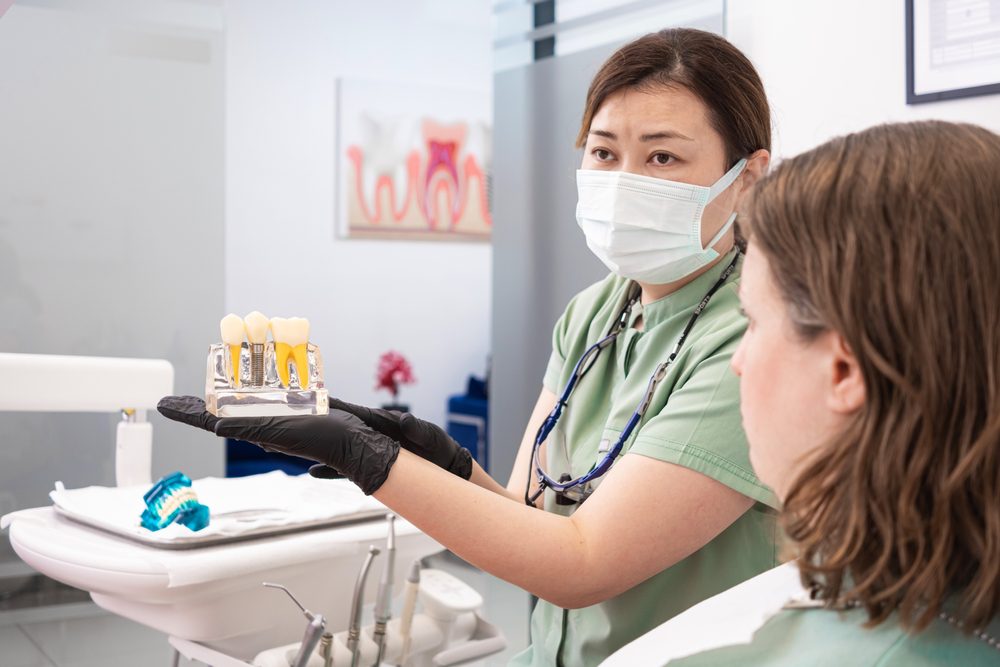
Both types of implant denture are held by implants in the jawbone, but they work differently day to day. A removable (snap-in) implant denture clips onto two to four implants, and you take it out to clean it. A fixed implant denture is screwed to the implants, and only your dentist can remove it.
Neither is the right answer for everyone. At Shield Dental Care in Burke, VA, we offer both, and the choice depends on your bone, your health, how you want your teeth to feel and how much you want to spend. This article compares them side by side so you can go into a consultation knowing which questions matter to you.
How a removable (snap-in) implant denture works
A removable implant denture, also called an overdenture, looks like a conventional denture but has attachments on its underside. Those attachments clip onto implants in the jaw, or onto a bar that joins the implants, so the denture stays put while you eat and talk. Each night you unclip it, clean it and clean around the implants.
According to WebMD, snap-in dentures usually need only two to four implants. Because the denture still rests partly on the gums, it can use fewer implants than a fixed bridge. The attachments are the parts that wear: WebMD notes that the snap-in sections eventually need to be replaced because they wear out over time.
How a fixed implant denture works
A fixed implant denture, sometimes called a hybrid denture or full-arch bridge, is screwed to the implants. It does not rest on your gums and you do not take it out. Cleveland Clinic describes it as attaching permanently to the implants and staying in until a dentist removes it.
The best-known approach is All-on-4, which supports a full arch of teeth on four implants, with the two back implants tilted to use the available bone. Some plans use more than four implants, depending on the bone and the bite. Our page on All-on-4 dental implants in Burke explains how we plan and place them.
Side-by-side comparison
- Stability: Both are far steadier than a conventional denture. A fixed denture does not move at all; a snap-in denture can have a little movement because it also rests on the gums.
- Number of implants: Snap-in usually two to four. Fixed usually four or more.
- Feel: A fixed denture feels more like natural teeth. In the upper jaw it does not need to cover the roof of the mouth, which many people notice most with taste and speech.
- Cleaning: A snap-in denture comes out for cleaning at the sink. A fixed denture stays in and is cleaned in the mouth with a soft brush, floss threaders, interdental brushes or a water flosser.
- Upkeep: Snap-in attachments wear and are replaced periodically. Fixed teeth need professional maintenance visits, when your dentist may remove and clean them.
- Cost: Snap-in dentures generally cost less because they use fewer implants and simpler parts. Fixed full-arch teeth cost more.
- Night-time: A snap-in denture usually comes out overnight. Fixed teeth stay in.
Who tends to choose a snap-in implant denture
- People who want a big improvement over a loose denture at a lower cost.
- People whose bone or health makes fewer implants the sensible choice.
- People with limited hand strength or dexterity who would find cleaning around a fixed bridge harder than cleaning a denture at the sink.
- People who already wear a lower denture and mainly want it to stop moving.
That last point matters. Many people manage an upper denture reasonably well but struggle with a lower one. A 2011 review in the Journal of Medicine and Life noted that while most patients can tolerate an upper denture, the lower denture is a different story, and described a two-implant lower overdenture as the first alternative treatment for a toothless lower jaw.
Who tends to choose fixed implant teeth
- People who want teeth that never come out and feel as close to natural teeth as possible.
- People who do not want anything covering the roof of the mouth.
- People who are losing their remaining teeth and want to go from failing teeth to fixed teeth with no removable stage.
- People with enough bone, or a plan such as tilted implants, to support four or more implants.
This is the type of full-arch treatment our full mouth implant offer covers: fixed, non-removable teeth with final porcelain zirconia teeth.
What daily life is like with each
With a snap-in denture
You put the denture in in the morning and it clicks into place. You can eat most foods with more confidence than with a conventional denture. At night you take it out, brush it with a soft brush and a nonabrasive cleanser, clean around the implants and attachments, and store it as your dentist recommends.
With fixed teeth
There is nothing to put in or take out. You brush twice a day and clean under the bridge where it meets the gums, which takes a little practice at first. You come in for regular maintenance visits so the implants, gums and screws can be checked. Our guide to caring for dental implants covers the routine.
Can you switch later?
Sometimes. Someone with a snap-in denture can later move to fixed teeth if there is enough bone and the implants are in suitable positions, which may mean adding implants. It is easier to plan for the option you want from the start, so tell us at your consultation if fixed teeth are your long-term goal.
How we help you decide
At your consultation we take a CBCT scan and digital impressions to see your bone and bite, then talk through both options with you, including what each would involve and cost. Dr. Ghorbani will tell you if one option is clearly better for your mouth, and why. If you currently wear dentures, our article on switching from dentures to implants is a good next read, and our dentures page covers conventional options.
To see what fixed full-arch treatment includes and what it costs, visit our full-arch implant page, or call (703) 250-5072.
Frequently Asked Questions
Frequently Asked Questions
Frequently Asked Questions
Frequently Asked Questions
What is the difference between fixed and removable implant dentures?+
A removable (snap-in) implant denture clips onto implants and comes out for cleaning. A fixed implant denture is screwed to the implants and only your dentist can remove it.
How many implants does a snap-in denture need?+
Usually two to four. Fixed full-arch teeth usually need four or more, depending on your bone and bite.
Is a fixed implant denture better than a snap-in one?+
It feels more like natural teeth and never comes out, but it costs more and needs careful cleaning under the bridge. A snap-in denture is a strong, lower-cost upgrade from a loose denture. The better choice depends on your bone, health and priorities.
Does an upper implant denture cover the roof of my mouth?+
A fixed upper bridge does not. Some removable upper implant dentures can be designed with less palate coverage than a conventional denture, but it depends on the number of implants and your anatomy.
Do snap-in implant dentures need maintenance?+
Yes. The attachments that clip onto the implants wear over time and are replaced periodically, and the denture itself may eventually need relining or replacing.
Cavities develop gradually, not overnight. Bacteria in your mouth feed on sugars and starches, producing acids that pull minerals from your enamel. Saliva repairs some damage, but frequent acid attacks overwhelm it, and plaque lets bacteria attack the tooth directly. Left unchecked, decay progresses from the enamel into the dentin, pulp, and eventually an abscess. Good hygiene, diet, and regular dental visits keep cavities preventable.