
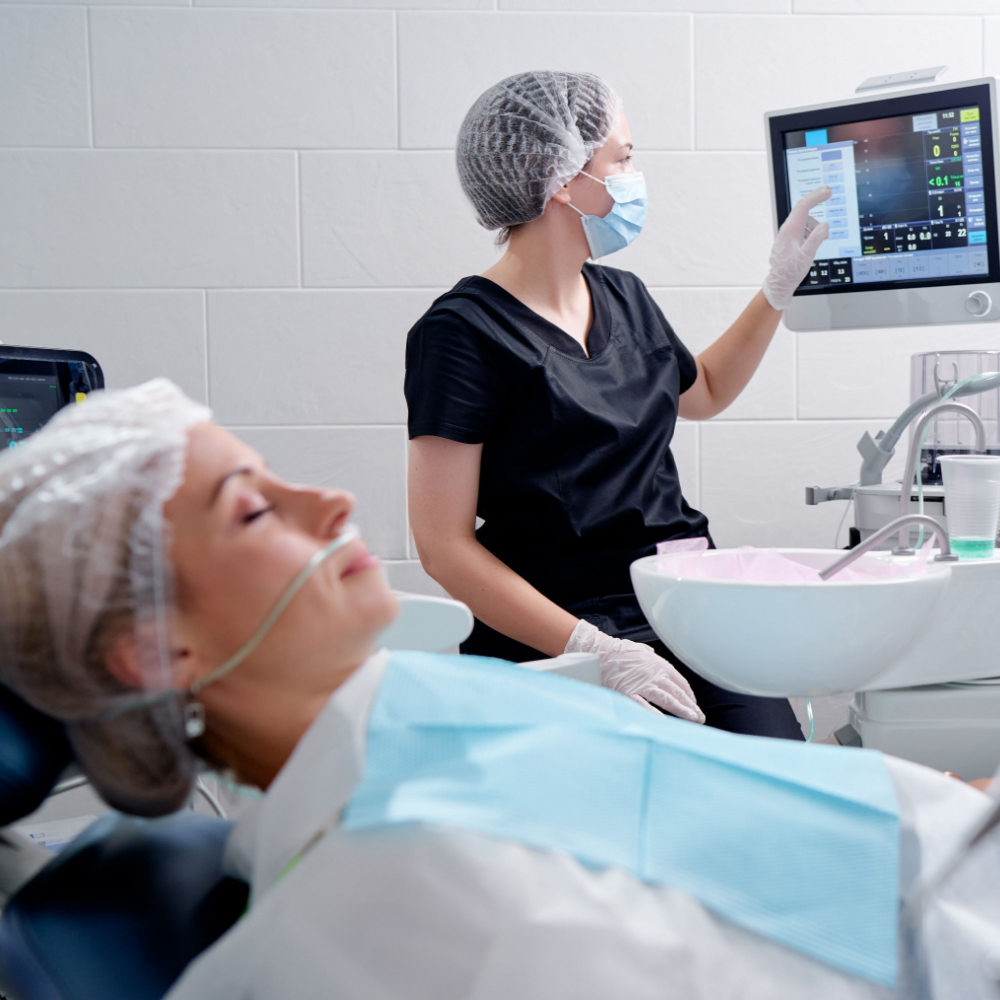
Yes, you can be put to sleep for dental work, but most people who ask this do not actually need to be. True general anesthesia, where you are fully unconscious and need help breathing, is available for dentistry, usually from a dental anesthesiologist, an oral surgeon or an anesthesia team, and sometimes in a surgery center or hospital. Most anxious patients do very well with sedation instead: you are deeply relaxed, may drift off and remember little, but you keep breathing on your own. Shield Dental Care offers nitrous oxide, oral sedation and IV sedation, and if general anesthesia is the safer route for you, we will explain why and refer you. Our sedation dentist page covers the options we provide in Burke.
What “sleep dentistry” usually means
“Sleep dentistry” is a marketing phrase, not a medical term. Offices use it for anything from laughing gas to full general anesthesia. Before you book, ask which level of sedation is meant, because the experience, the preparation, the safety requirements and the cost differ a lot.
The four levels, in plain English
The American Society of Anesthesiologists and the American Dental Association both describe sedation as a continuum with four levels:
- Minimal sedation. You are relaxed and less worried but respond normally when spoken to. Nitrous oxide on its own usually sits here.
- Moderate sedation. You are drowsy, may doze, and may not remember much, but you respond purposefully when spoken to or lightly touched, and you breathe without help. This is what many people mean by being “asleep” at the dentist.
- Deep sedation. You cannot be easily woken and respond only to repeated or painful stimulation. Your breathing may need support.
- General anesthesia. You are unconscious and cannot be woken, even by pain. You usually need help keeping your airway open, and sometimes breathing support.
The ADA’s guidelines also point out that the level depends on the drugs and doses used, not on whether they are given as a pill, a gas or through a vein. A higher dose of any of them can take a patient deeper than intended, which is why each level comes with its own training, monitoring and equipment requirements.
Why most dental work does not need general anesthesia
Most dental treatment is done with local anesthetic, which numbs the area completely. What frightens people is usually not pain on the day but the sounds, the sensations, the loss of control and memories of past visits. Sedation deals with exactly that.
With oral sedation or IV sedation, many patients describe the visit as feeling like a few minutes, with little memory of it afterwards. To an anxious patient, that can feel very much like having been asleep, without the extra preparation and recovery of general anesthesia. Our article on general anesthesia vs. IV sedation compares the two in more detail.
When general anesthesia may be the better choice
General anesthesia is a reasonable choice in some situations. Your dentist may suggest it, or a referral for it, when:
- a patient cannot cooperate with treatment even with sedation, for example some young children or people with certain developmental or cognitive conditions;
- the treatment is long or surgically complex;
- a severe phobia has not responded to lighter sedation;
- a medical condition makes treatment in a hospital or surgery center safer.
It also brings more to plan for: stricter fasting, a longer recovery, an anesthesia provider and sometimes a facility fee. Our article on sedation for patients with special needs covers some of these situations.
Who is allowed to provide each level
Deeper sedation needs more training and more safety measures. In Virginia, the Board of Dentistry requires a dentist to hold a permit, with an office inspection for each location, before providing moderate sedation, and a separate permit for deep sedation and general anesthesia (18VAC60-21-290 and 18VAC60-21-300). A dentist without the relevant permit may bring in a qualified dentist, anesthesiologist or certified registered nurse anesthetist to provide it. Dental anesthesiology has also been a recognized dental specialty since 2019.
You are entitled to ask who will be giving your sedation, what level they intend, what training and permit they hold, and how you will be monitored. Our guide on how to choose a sedation dentist lists the questions worth asking.
Getting ready for deeper sedation
Whatever level you have, preparation matters. Expect instructions about when to stop eating and drinking, which medicines to take that morning and who will drive you home. Tell your dentist about every medicine, especially sedatives, opioids and weight-loss injections (see GLP-1 medicines and dental sedation), and about conditions such as sleep apnea. Our guide to preparing for sedation walks through the checklist.
What we offer at Shield Dental Care
At Shield Dental Care in Burke, Dr. Pejman Ghorbani offers three levels: nitrous oxide, oral sedation and IV sedation. He reviews your medical history, asks what makes dental visits hard for you, and recommends the level that fits your health and your treatment. With oral or IV sedation you will need a companion to drive you home. We do not provide general anesthesia in our office; if we think it is the safer option for you, we will tell you and help you find the right provider.
If you have been putting off care because you want to be “out” for it, talk to us first. Many patients find a lighter option is enough. Learn more on our sedation dentist page or call (703) 250-5072.
Frequently Asked Questions
Frequently Asked Questions
Frequently Asked Questions
Frequently Asked Questions
Can I be put to sleep for a dental cleaning?+
General anesthesia is rarely used for a routine cleaning. Nitrous oxide or oral sedation is usually enough to help an anxious patient through a cleaning. See sedation for a dental cleaning
Is IV sedation the same as being put to sleep?+
Not quite. IV sedation is usually moderate sedation: you may doze and remember little, but you breathe on your own and can respond. General anesthesia means full unconsciousness.
Is general anesthesia for dental work safe?+
It is generally safe when given by a properly trained and permitted provider with the right monitoring, but it carries more risk and a longer recovery than lighter sedation. That is why it is usually kept for cases that need it.
Does Shield Dental Care offer general anesthesia?+
No. We offer nitrous oxide, oral sedation and IV sedation. If general anesthesia is the safer choice for you, we will explain why and refer you.
Will I remember anything if I am sedated?+
It varies. With oral or IV sedation many people remember little or nothing. With nitrous oxide you usually remember the visit but feel calm through it.
Cavities develop gradually, not overnight. Bacteria in your mouth feed on sugars and starches, producing acids that pull minerals from your enamel. Saliva repairs some damage, but frequent acid attacks overwhelm it, and plaque lets bacteria attack the tooth directly. Left unchecked, decay progresses from the enamel into the dentin, pulp, and eventually an abscess. Good hygiene, diet, and regular dental visits keep cavities preventable.