
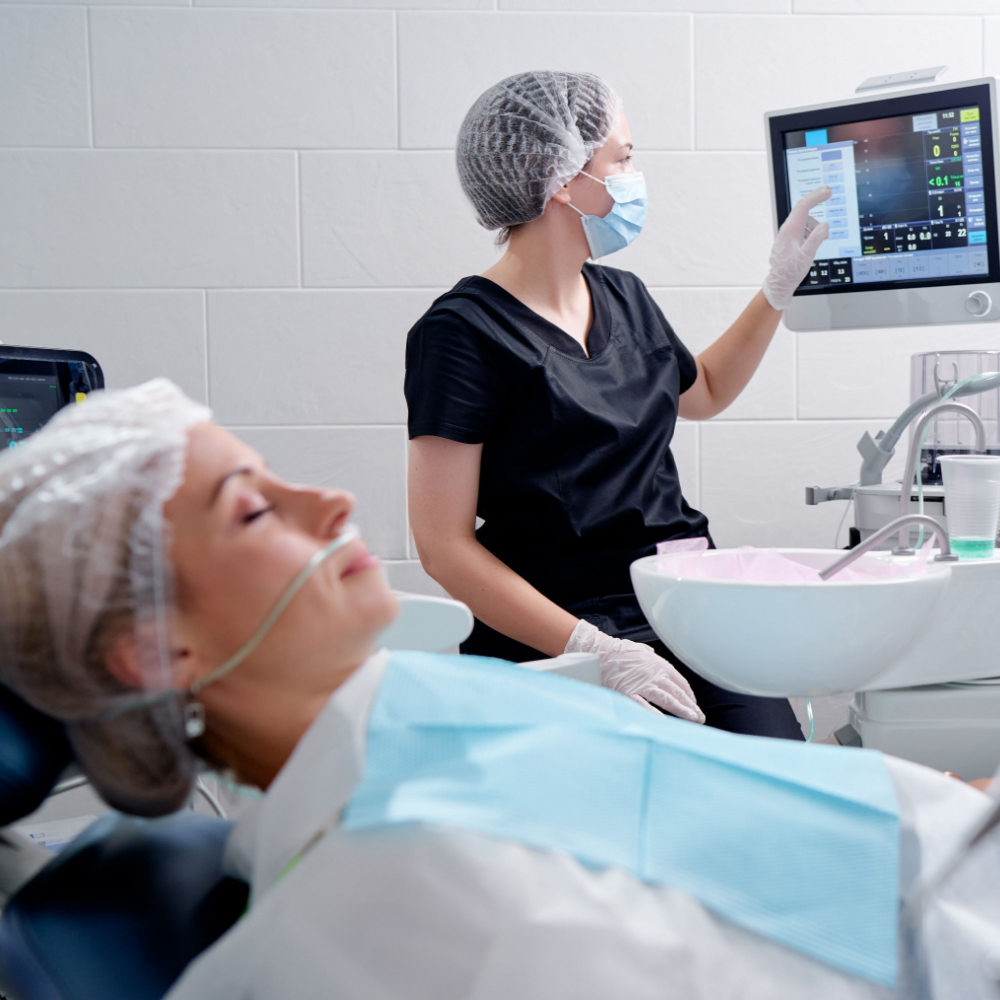
IV sedation at the dentist follows a predictable path: a medical review and written instructions beforehand, a small IV line placed in your hand or arm on the day, continuous monitoring while sedative medication relaxes you, your dental treatment with local anesthetic, and a recovery period before a responsible adult takes you home. You stay able to breathe on your own and respond, but most people feel deeply relaxed and remember little of the visit. Plan to rest for the rest of the day.
This is the step-by-step version. If you are still deciding between IV sedation and general anesthesia, read our comparison of general vs. IV sedation dentistry. For every level we offer, see sedation options at Shield Dental Care.
What IV sedation is, in plain terms
“IV” means intravenous: the medication goes straight into a vein through a thin, flexible tube. Because it acts quickly, the dose can be adjusted during the appointment, which is why IV sedation is often chosen for longer treatment and for people with severe anxiety.
The American Society of Anesthesiologists describes sedation as a continuum. At moderate sedation, a person responds purposefully to speech or a light touch, keeps their own airway open without help and breathes adequately on their own. That is the zone dental IV sedation usually aims for. It is sometimes called “twilight” sedation. It is not general anesthesia, where a person cannot be roused.
Before the day
The consultation
Dr. Pejman Ghorbani reviews your medical history, your medications and supplements, any past reactions to sedation or anesthesia, and what worries you about treatment. Some conditions need extra care, including sleep apnea, heart and lung conditions and pregnancy. Some medicines matter too: tell us if you take a GLP-1 medicine such as semaglutide, which can slow stomach emptying (see GLP-1 medicines and dental sedation), or anti-anxiety medicines (see taking Xanax or Valium before the dentist).
Your instructions
You will get written instructions. They usually cover:
- When to stop eating and drinking. Follow the times you are given exactly. An empty stomach lowers the risk of stomach contents reaching the lungs while your reflexes are dulled.
- Your regular medicines. Which to take as normal on the day and which to pause. Do not stop a prescribed medicine unless you are told to.
- Your companion. A responsible adult must bring you, wait or be reachable, and take you home. In Virginia, the Board of Dentistry’s rule for moderate sedation requires a patient to be discharged with a responsible adult who has been instructed in their care.
- What to wear. Loose, comfortable clothing with sleeves that roll up easily.
Our guide to preparing for sedation dentistry covers the practical side in more detail.
On the day, step by step
1. Check-in and baseline readings
We confirm your health history, your instructions and your ride home. Your baseline vital signs are recorded before any sedative is given. Virginia’s rule for moderate sedation requires baseline vital signs, including oxygen saturation, to be taken and recorded first.
2. Placing the IV
A small needle is used to place a thin tube in a vein, usually on the back of the hand or the inside of the arm. The needle is then removed and only the soft tube stays. Most people describe it as a quick pinch. If needles are a big fear for you, say so; see fear of needles at the dentist.
3. Monitoring starts
Your breathing, oxygen level, heart rate and blood pressure are monitored throughout the procedure and recovery. American Dental Association guidelines call for continuous pulse oximetry during moderate sedation and monitoring of breathing, including exhaled carbon dioxide.
4. The sedative takes effect
Medication is given through the IV and you begin to feel heavy, calm and unconcerned within minutes. The dose is adjusted to keep you relaxed and comfortable.
5. Numbing and treatment
IV sedation calms you but does not numb your mouth. Once you are relaxed, local anesthetic is used in the area being treated, and then your dental work is done. You can still respond if spoken to. Many people later feel as if the visit took minutes. Our article on what dental sedation feels like describes the experience.
6. Recovery
When treatment is finished, the medication is stopped and you rest while it starts to wear off. Monitoring continues. You are discharged only once you are awake enough and your breathing, oxygen level, blood pressure and heart rate are satisfactory, with written and verbal aftercare instructions.
The rest of the day
IV sedation can affect judgment and coordination for hours after you feel awake. University dental and oral surgery services typically advise patients not to drive, operate machinery, drink alcohol, sign legal documents or make important decisions for 24 hours after IV sedation.
- Have your companion take you straight home.
- Rest, and have an adult with you for the first several hours.
- Eat soft food once you are ready and the numbness has worn off.
- Follow your aftercare instructions, and call us with any concerns.
Most people feel back to normal by the next day. See how long dental sedation lasts for more on recovery.
Is IV sedation right for you?
IV sedation is often a good fit if you have severe dental anxiety or phobia, a strong gag reflex, need a long or complex procedure, or want to combine several treatments into one visit. For milder anxiety or shorter visits, nitrous oxide or oral sedation may be enough. See am I a candidate for dental sedation? and our article on dental sedation safety.
To find out whether IV sedation suits your treatment and health, read about sedation options at Shield Dental Care, call (703) 250-5072 or request an appointment at our office in Burke, VA.
Frequently Asked Questions
Frequently Asked Questions
Frequently Asked Questions
Frequently Asked Questions
Will I be asleep during IV sedation?+
Not fully. Dental IV sedation usually keeps you in a deeply relaxed state where you can still breathe on your own and respond to speech. Many people remember little of it afterward, so it can feel like sleep.
Does the IV hurt?+
Most people feel a brief pinch as the small needle goes in. The needle is removed, leaving only a soft tube, and you will not feel the tube once the sedative is working.
Do I still need a numbing shot with IV sedation?+
Yes. IV sedation relaxes you but does not numb your mouth, so local anesthetic is used for the treatment. By then most people are too relaxed to mind it.
How long after IV sedation can I drive?+
Do not drive for at least 24 hours, or longer if you are told to. You need a responsible adult to take you home.
Can I eat before IV sedation?+
Only as your instructions allow. You will be told when to stop eating and drinking beforehand. Follow those times exactly, because an empty stomach is a safety measure.
How long does IV sedation take to wear off?+
You will feel more awake within a short time after the medication is stopped, but drowsiness and slower reactions can last for hours. Plan to rest for the rest of the day.
Cavities develop gradually, not overnight. Bacteria in your mouth feed on sugars and starches, producing acids that pull minerals from your enamel. Saliva repairs some damage, but frequent acid attacks overwhelm it, and plaque lets bacteria attack the tooth directly. Left unchecked, decay progresses from the enamel into the dentin, pulp, and eventually an abscess. Good hygiene, diet, and regular dental visits keep cavities preventable.