
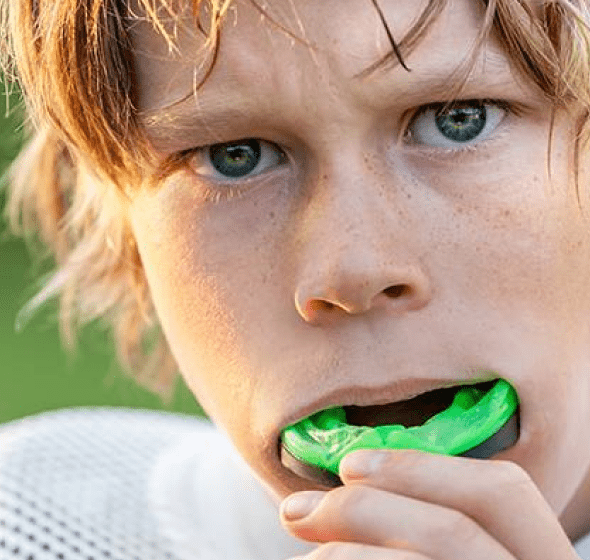
Every season, Springfield parents get an equipment list from a coach, and somewhere between the cleats and the practice jersey is a single line: mouthguard required. It is the cheapest item on the list and the easiest to treat as an afterthought. This guide covers which sports actually require one, how the different types compare, what athletes with braces need, and what to do on the sideline if a tooth gets knocked out anyway.
Which high school sports require a mouthguard
Fairfax County high schools compete in the Virginia High School League, and the VHSL plays most sports under the playing rules of the National Federation of State High School Associations. The NFHS position statement on mouthguards, last revised in October 2025, says the federation mandates mouthguards in football, field hockey, ice hockey, lacrosse and wrestling, the last one only for wrestlers who wear braces.
For a family at West Springfield High School, John R. Lewis High School (the former Lee High School) or Lake Braddock Secondary just up the road in Burke, that usually means a mouthguard for fall football and field hockey and for spring lacrosse. Individual programs can add their own rules on top. Some lacrosse and football programs, for example, ask for a solid-colored guard and a spare, so read the team's equipment sheet as well as the rulebook.
Sports where it is optional but still smart
The NFHS sports medicine committee goes further than its own rules and recommends a properly fitted mouthguard for any sport where a body, stick, bat or ball can hit the face. The ADA's consumer site lists many of them, including basketball, soccer, baseball, softball, volleyball, gymnastics, martial arts and skateboarding, on its mouthguard page. Think of the sports parents file as "non-contact": an elbow under a basketball rim, a softball that takes a bad hop or a fall off a board can still chip a front tooth.
What a mouthguard does and does not do
A well-fitted guard cushions a blow and spreads its force, which protects the front teeth, the lips and cheeks, and the gums. What it does not do is prevent concussions. The NFHS statement is explicit that current research does not support the idea that a mouthguard lowers the risk or severity of a concussion. That matters because some products are marketed with brain-protection language. Buy a mouthguard to protect teeth, and rely on the school's concussion protocol for head injuries.
The three types, compared
The NFHS statement lists three types that comply with its rules. Each has a place.
- Stock. Pre-formed and ready to wear out of the package. Cheap and easy to fit over braces, but they tend to fit loosely, fall out, and make it harder to talk and breathe hard. Athletes who dislike them often chew them or leave them on the bench, which defeats the purpose.
- Mouth-formed ("boil and bite"). Softened in hot water and molded by biting into it. Inexpensive and a big improvement on stock guards when fitted carefully. They can wear down over a season and may need replacing before it ends.
- Custom. Made in a dental office from an impression or scan of the athlete's teeth. The NFHS lists an accurate fit and comfort as advantages and notes that custom guards may offer better protection; the trade-offs are cost and the need for a dental visit or two.
Whatever the type, a guard should separate the biting surfaces, cover all of the upper teeth and stay put without the athlete clenching to hold it in place. Trimming a guard to make it smaller, or chewing the back off, reduces the protection and is discouraged by the NFHS. If your son or daughter has a strong underbite, ask the dentist whether a lower guard makes more sense.
Braces, color rules and replacing a guard
Athletes in braces need a guard that covers the brackets and leaves room for the teeth to keep moving. A custom guard made at the start of orthodontic treatment can stop fitting within months, so many orthodontic patients use a guard designed for braces and replace it as needed. Wrestlers with braces must cover both upper and lower appliances.
In the sports where guards are required, officials generally need to see them, which is why football and several other rule codes call for a visible color rather than clear or white. Pick a bright color and you avoid an argument at the equipment check.
Replace a guard when it is torn, chewed through, loose or no longer covers the back teeth. Growing teenagers and those with new adult teeth coming in often outgrow a guard between seasons. Rinse it after every use, let it dry in a vented case, and keep it out of a hot car.
Timing it around the season
If you want a custom guard, plan a few weeks before tryouts rather than the week practice starts. Late summer and the weeks before spring sports are busy at every dental office in the county. An easy approach is to ask at your child's regular checkup, so the impression or scan is done during a visit you were already making. If your teen also grinds at night, mention it: a sports guard and a night guard for Springfield patients who grind their teeth are built differently and are not interchangeable.
If a tooth is knocked out at a game
An adult tooth that is knocked out can sometimes be saved if you act fast. The American Association of Endodontists advises the following steps, and the goal is to see a dentist within about 30 minutes:
- Pick the tooth up by the crown, the white chewing part, never the root.
- If it is dirty, rinse it briefly with water only. Do not scrub it, dry it or wrap it in tissue.
- If the athlete is alert and able, gently push it back into the socket and have them bite on gauze or a clean cloth to hold it.
- If that is not possible, keep it moist in milk or in the athlete's cheek, or in a tooth-preservation kit if the trainer has one.
Do not try to put a knocked-out baby tooth back in. And if the athlete was knocked unconscious, is confused, has a suspected jaw fracture, or has bleeding that will not stop or trouble breathing or swallowing, call 911 or go to the emergency room first; the tooth comes second. For deciding between an urgent dental visit and a hospital, our guide to where to go for a dental emergency in Springfield helps, and our page for Springfield patients who need an emergency dentist explains how to reach us.
Shield Dental Care makes custom sports mouthguards, and we are a Burke practice a few minutes from West Springfield. If a mouthguard is on this season's equipment list, mention it at your teen's next checkup, or see our dentist page for Springfield families for directions and booking.
Frequently Asked Questions
Frequently Asked Questions
Frequently Asked Questions
Frequently Asked Questions
Is a boil-and-bite mouthguard allowed in high school football?+
Yes. The NFHS lists mouth-formed guards as compliant, along with stock and custom guards. What matters is that it fits, covers the upper teeth and has not been cut down. Check your team's sheet for any color requirement.
Does a mouthguard prevent concussions?+
No. The NFHS states that research does not support mouthguards reducing the risk or severity of concussion. They protect teeth, lips and gums; head injuries are handled through the school's concussion protocol.
Can my teen use their night guard for sports?+
No. A night guard is usually a thin, hard appliance designed for grinding during sleep. A sports guard is thicker and cushioned to absorb impact. Using one for the other job leaves the teeth under-protected.
How often should a sports mouthguard be replaced?+
At least whenever it is torn, chewed, loose or no longer covers the back teeth. Growing athletes and those in braces often need a new one every season or sooner.
Cavities develop gradually, not overnight. Bacteria in your mouth feed on sugars and starches, producing acids that pull minerals from your enamel. Saliva repairs some damage, but frequent acid attacks overwhelm it, and plaque lets bacteria attack the tooth directly. Left unchecked, decay progresses from the enamel into the dentin, pulp, and eventually an abscess. Good hygiene, diet, and regular dental visits keep cavities preventable.